Oil & Gas Isn't Short on Data. It's Short on Execution Context.
Oil and gas operators are investing seriously in digital: IIoT sensors, industrial data platforms, digital twins, and AI pilots. Yet for many operators, the biggest data gap isn't in the control system or the historian. It's in the field.
The work that technicians, operators, and maintenance crews do every day is still largely captured on paper, in static PDFs, or not at all. That includes the steps they follow, the readings they record, and the judgment calls they make. It's the blind spot in many digital transformation strategies, and it's worth closing before the next AI initiative gets funded.
Plenty of data, not enough context
Most operators aren't short of data. They're short of context. Sensor data tells you a pump's pressure dropped at 2:14 p.m. It doesn't tell you that a technician was midway through an isolation procedure, skipped a verification step, or flagged a condition that never made it into a work order.
That context lives in how work actually gets done. When execution happens on paper, it stays locked in binders, clipboards, and people's heads. Engineering, operations, and safety teams end up making decisions from data that describes the asset but not the work performed on it.
The result is a familiar set of problems:
- Procedures that drift from how the work is really done
- Deviations and near misses that go unrecorded or are entered days later
- Audits that depend on chasing signatures and scanning paper
- Hard-won field knowledge that walks out the door when experienced workers retire
Procedures are where the work and the data meet
Procedures sit at the intersection of safety, compliance, and operational knowledge. They define how critical tasks should be performed, from startups and shutdowns to lockout/tagout, inspections, and maintenance.
That makes procedure execution one of the richest sources of operational data in any facility. Every completed step, recorded value, sign-off, and exception is a data point about how the operation actually runs.
On paper, almost none of it is usable. A completed checklist proves a task was signed off. It doesn't tell you how long each step took, where crews hesitated, or which steps generate the most deviations across sites.
Turn work into data
Digitalizing procedure execution changes what a procedure produces. Instead of a signed piece of paper, every job creates a structured, timestamped record of how the work was done.
When crews execute digital procedures on a connected device, the data is captured as the work happens:
- Step completion and timing, so you can see where work flows and where it stalls
- Recorded values and readings, validated in the moment instead of transcribed later
- Sign-offs and approvals, tied to the person and the step
- Comments and exceptions, surfaced while there's still time to act on them
That record closes the loop between the people who write procedures and the people who execute them. Engineers can see which steps cause confusion. Supervisors can spot issues before they become incidents. Procedure owners can improve content based on evidence rather than anecdotes.
You can't scale AI on work you can't see
AI and advanced analytics are only as good as the data behind them. Models trained on sensor and asset data alone miss the human side of operations: what was done, by whom, in what order, and what happened when the procedure didn't match reality.
Execution data fills that gap. It gives analytics teams a reliable record of field activity they can connect to asset performance, maintenance history, and safety outcomes. That's what makes operations AI-ready.
It also makes scaling possible. Rolling a digital initiative out across sites requires a consistent way of working, and consistent data to measure it. Digital procedures give operators a common foundation:
- One governed version of each procedure across sites
- Comparable execution data from every location
- A faster path from pilot to enterprise deployment
- Field adoption built into the way work already gets done, not layered on top of it
Safer, more resilient operations start with consistent execution
Process safety depends on the right work being done the right way, every time. Digital procedures support that by building governance into execution, not bolting it on afterward.
- Consistency: crews always work from the current, approved version, with critical steps enforced rather than assumed
- Auditability: a complete execution record is available the moment the job is done, ready for internal review or regulators
- Continuous improvement: feedback and exceptions from the field flow straight back to procedure owners
- Knowledge retention: expertise is captured in the procedure and the data, not only in the people who carry it today
For operators facing aging infrastructure, a changing workforce, and evolving regulatory requirements, that consistency is a foundation for resilience.
Close the gap between the field and the data
The next phase of digital transformation in oil and gas won't be won by collecting more data. It will be won by connecting the data operators already have to the work that produces it. Frontline execution is the missing piece, and procedures are the place to start.
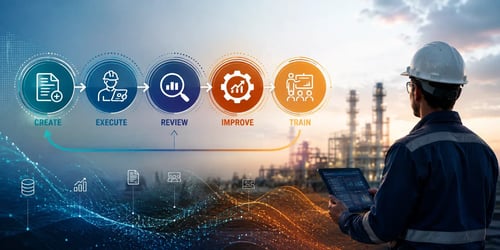
ATR SmartProcedures helps operators create, execute, review, improve, and train on procedures digitally, turning every job in the field into operational intelligence.
Meet ATR in Houston
We'll be at the Digital Oil & Gas Summit USA on December 2-3 at the C. Baldwin in downtown Houston. If you're attending, let's find 25 minutes to talk about turning field execution into data you can use.
Not attending? Book a conversation with our team.
About ATR SmartProcedures®
ATR helps industrial organizations operationalize mission-critical work through a Connected Worker platform that digitizes procedures, guides execution, captures operational data, and enables AI-driven continuous improvement.
By connecting people, digital processes, and operational intelligence, ATR empowers organizations to improve safety, reduce risk, increase productivity, and build the trusted operational data foundation required for the next generation of industrial AI.
Learn how ATR SmartProcedures supports digital procedure management across the full procedure lifecycle.